
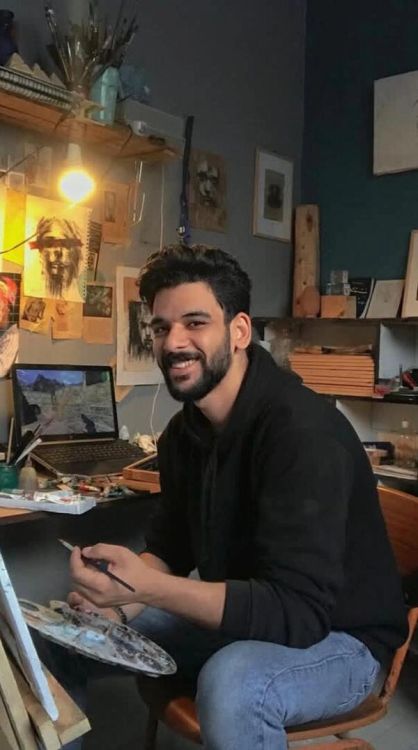
Osama Hussien
Dates unknown
Biography
I am Osama Hussein, a Palestinian artist from Khan Younis, Gaza.
I was born and raised in Gaza, a place that carries in every corner stories of steadfastness, suffering and hope. From my earliest years, art has been my window into the world, and my means of understanding complex reality and self-expression.
As an artist from Gaza, life here is a constant source of inspiration for me, with all the challenges and dreams it carries. Under sieges, bombardment and conflicts, art becomes a means of survival, not only alive, but also human. Through my actions, I express the internal conflict that every human being lives in on this earth, and about the language of the body, which carries with it untold stories.
Art for me is not just lines and colors, but a silent voice that shouts in the face of injustice, asking for change. I aspire to show the world that Gaza is not only a place of conflict, but also home to creativity and dreams. I want the viewer to feel every detail in my work, to reflect on and interact with them, and to realize that art can be an instrument for change, and a means of rebuilding man.
Every painting I paint carries with it part of my identity as a Palestinian, of the suffering of my people, and of their steadfastness. I work on translating these stories into works that reflect internal conflicts, focusing on body language that I see as the truest expression of pain and hope.
Art Before and After War: A Journey of Survival and Expression
Before the War: A Safe Corner for Creativity
Before the war, I had my own small studio. It wasn’t big, but it was my safe space.It was filled with my scent, my light, and my silence. I knew how my day started and how it ended.
There were rituals—soft music, the right lighting, and a canvas that grew slowly, stroke by stroke.I worked on myself as an artist with patience and passion. My focus was on the meaning of movement, the body, and the empty space. I explored the connection between inner feelings and their visual form.
In that space, I could concentrate, experiment, and discover myself through art. I was not in a rush, not under pressure, and not afraid of the next moment.
After the War: When Art Became Survival
But after the war, everything changed. Not only did my surroundings collapse, but my way of working transformed too.I began creating under pressure, under daily pain, and under a loss that words can hardly describe.
The canvas was no longer a meditative project—it became a reaction to reality.Lines grew heavier, bodies on the canvas became real bodies—ones I saw, lost, or feared for.
I painted to protect myself from breaking down. I painted to document, not to beautify.I painted to leave a trace, even if it was small.
Art did not lose its importance, but its role shifted. It became a means of survival, a tool of understanding, a way to face destruction.
Creating Without Stability
I lost my place, much of my work, and the stability that fueled my creativity.Now, I often paint in temporary spaces—sometimes without a table, without proper light, without my tools, and without silence.
Most importantly, I lost the safe distance between myself and reality.Art became faster, less organized, less hesitant. It turned into an immediate response—documentation of the moment, not long reflection.
The spaces on my canvas became either too narrow or unexpectedly wide, as if I no longer had the luxury of arranging everything carefully. I painted as if I were in a state of emergency.
Why I Still Create
And yet, I never stopped. Because for me, art is not a luxury—it is survival.It is the way I make sense of what’s happening around me.It is the way I say: I am still here, despite all the destruction.
Before being an artist, I am a human.I grew up in an environment full of responsibility and hardship, but also warmth, love, and small details that taught me authenticity.
Living in the Moment
My personal and inner life changed. Loss, fear, and pressure became constants. Everything around us turned temporary, fragile, ready to collapse at any moment.
This reflected on me not only as an artist, but as a human being.I began living each moment as if it were the last scene.
Want to connect with the artist?
Preserved Artworks (22)
 Look Look
Unknown Year
 False Looks
2024
 A Family Photo From Gaza
2024
 Cold Hands
2024
 Empty Body
2024
 A Homeland in my Head
2024
 Embrace
2024
 Double Certificate
2024
 A Tent With It's Bodies Burning
2024
 Last Hug
2025
 I Have a Homeland In My Head
2024
 Embrace in the Fog
2024
 Women and Tent
2024
 Ambulance Vehicle
2025
 The Bound Body
2024
 Sufficiency
2025
 Red Pillow
2024
 Life or Death Card
2024
 Memory That Does Not Differentiate Between Two Faces
2024
 A Dying Homeland In My Mother's Lap
Unknown Year
 Parallel Departure
2024
 Return
2024